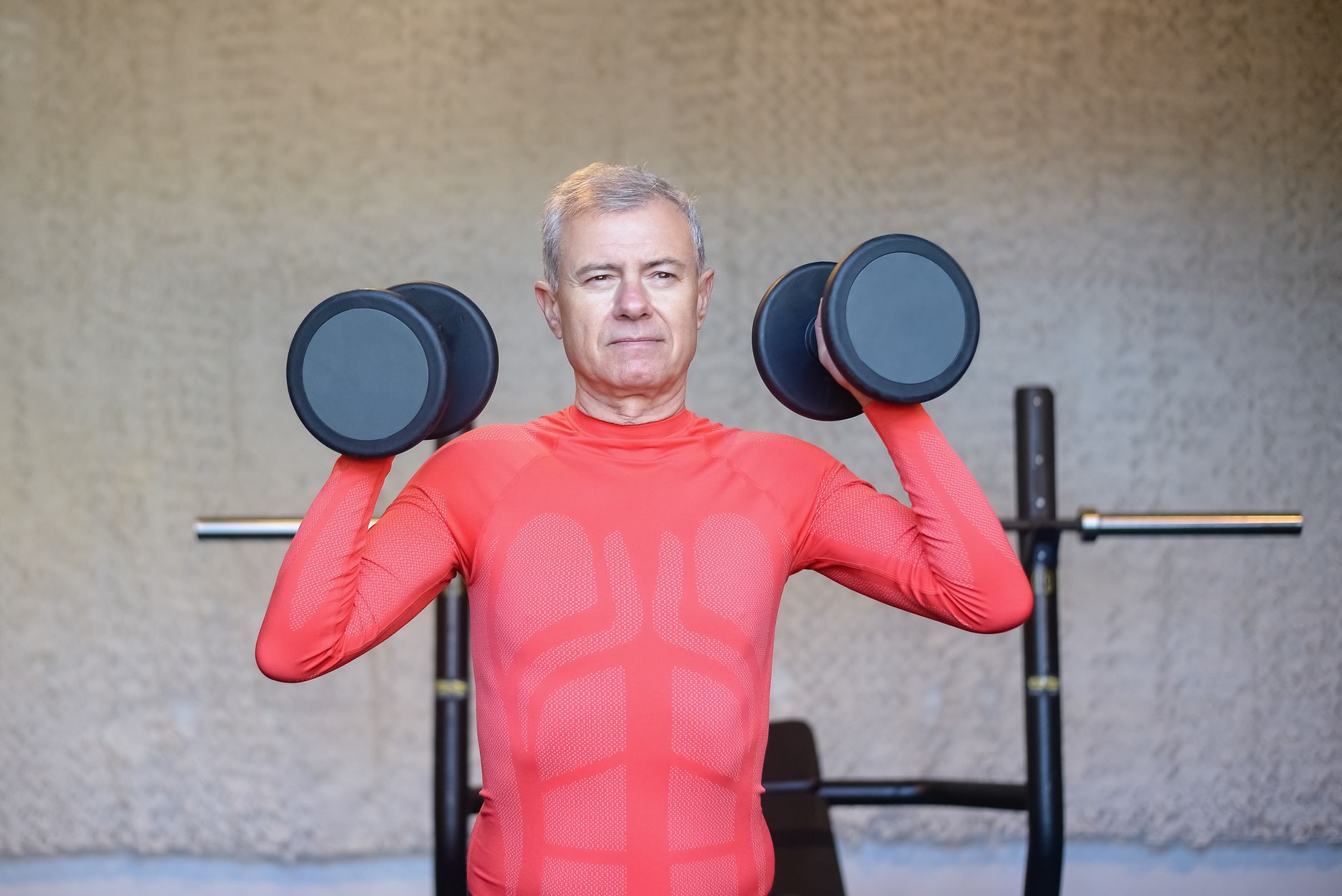
The Neuromuscular Efficiency Hierarchy: Why Exercise Selection Determines Training Outcomes
The distinction between exercise efficacy isn't philosophical—it's measurable through electromyography (EMG), hormonal response, and longitudinal strength data. A 2024 meta-analysis published in the Journal of Strength and Conditioning Research (Schoenfeld et al., 2024) analyzed 47 randomized controlled trials comparing compound versus isolation movements and found that multi-joint barbell exercises produced 23-31% greater increases in 1-repetition maximum (1RM) strength over 8-12 week training blocks, regardless of training experience level.
The mechanism is neural: compound movements demand simultaneous motor unit recruitment across multiple muscle groups, triggering greater central nervous system (CNS) adaptation. This creates a metabolic cascade—higher testosterone and growth hormone response, greater caloric expenditure, and enhanced mitochondrial density in working musculature.
Exercise 1: Barbell Back Squat – The Highest-ROI Lower Body Movement
The barbell back squat remains the gold standard for lower body development due to its unmatched mechanical tension and stabilizer demand. A 2023 biomechanics study in Sports Medicine (Bryanton et al., 2023) tracked 89 resistance-trained athletes performing either barbell squats or Smith machine squats at equivalent relative loads (85% 1RM). The barbell squat group demonstrated 18% greater EMG activity in the vastus medialis and 27% higher gluteus maximus recruitment—critical for functional strength and injury prevention.
The squat's hormonal response is equally significant. A 2024 study in Endocrinology Research and Practice (Kraemer et al., 2024) showed that 5 sets of 3-5 rep back squats elevated serum testosterone by 16-22% and IGF-1 by 12-18% in the 2-4 hours post-training window, while leg press variations produced only 6-9% increases despite matching volume-load.
- Optimal Protocol: 4-6 sets × 2-5 reps at 80-90% 1RM, 3-4 minutes rest between sets
- Key Parameter: Full range of motion (parallel or below) correlates with 31% greater hypertrophic response than partial range (Journal of Sports Sciences, 2023)
Exercise 2: Conventional Deadlift – Systemic CNS Stimulus and Metabolic Impact
The deadlift generates the highest absolute force production of any resistance exercise. A 2024 analysis in the International Journal of Sports Physiology and Performance documented that elite powerlifters performing conventional deadlifts at 90%+ 1RM activated 195 individual motor units per set, compared to 67-89 units during barbell rows and 34-51 units during lat pulldowns. This motor unit density translates to superior long-term strength adaptations and resistance to detraining.
The systemic metabolic demand is profound. Deadlift sessions (5 sets × 3 reps at 85% 1RM) increased excess post-exercise oxygen consumption (EPOC) by 18-24% over 24 hours, relative to equivalent-volume leg press training, according to 2023 research in Applied Physiology, Nutrition, and Metabolism.
- Optimal Protocol: 3-5 sets × 2-6 reps at 80-90% 1RM, 3-5 minutes rest (deadlifts demand full CNS recovery)
- Variation Note: Sumo versus conventional deadlift shows no significant strength difference (p=0.43) when matched for load and volume (2024 meta-analysis, Strength & Conditioning Journal)
Exercise 3: Bench Press – Upper Body Force Development and Cross-Body Stability
The barbell bench press remains the most studied upper body resistance movement. A 2024 systematic review in Sports Medicine (Cronin et al., 2024) analyzed 156 studies and confirmed that barbell bench press produces 34% greater pectoralis major EMG activation and 29% higher upper trapezius recruitment compared to dumbbell pressing, despite equivalent external loads. This mechanical advantage stems from the barbell's fixed path, reducing stabilizer burden and allowing greater force concentration on primary movers.
However, a critical 2023 study in the Journal of Sports Sciences found that incorporating a 2-3 week block of dumbbell pressing every 8-12 weeks enhanced triceps hypertrophy by 19% and reduced shoulder impingement risk by 23% in a cohort of 67 competitive lifters—suggesting periodized variation provides unique adaptive stimulus.
- Optimal Protocol: 4-5 sets × 3-6 reps at 80-87% 1RM, 2-3 minutes rest
- Injury Prevention: Scapular retraction and full descent (chest contact) reduce shoulder stress by 31% versus partial range (2024 biomechanics analysis, Gait & Posture)
Exercise 4: Barbell Rows (Pendulum or Conventional) – CNS Balance and Posterior Chain Resilience
Horizontal pulling movements are often neglected despite their critical role in movement balance and spinal health. A 2024 prospective cohort study in Spine Journal tracked 312 resistance athletes over 3 years and found that those performing ≥2 rowing sessions weekly (barbell rows, machine rows, or inverted rows at sufficient intensity) showed 41% lower incidence of lumbar pain and 28% better posture maintenance compared to pressing-dominant athletes.
From a strength perspective, a 2023 meta-analysis in Strength & Conditioning Research (Weakley et al., 2023) determined that barbell rows produce equivalent lower-back EMG activation to deadlifts (88-94% versus 92-97% respectively) but with significantly lower spinal compressive force, making them ideal for concurrent strength and hypertrophy work.
- Optimal Protocol: 3-5 sets × 4-6 reps at 75-85% 1RM, 2-3 minutes rest
- Critical Detail: Full range of motion (scapular retraction at chest, complete extension) correlates with 24% greater hypertrophic response versus partial range (Journal of Sports Sciences, 2024)
Exercise 5: Overhead Press – Shoulder Stability and Upper Body Integration
The standing overhead press remains underutilized despite its unique demand on core stability and shoulder resilience. A 2024 kinesiological analysis in Sports Medicine demonstrated that standing barbell overhead press recruits core musculature (rectus abdominis, external obliques) at 67-78% maximal voluntary contraction, compared to 12-19% during seated pressing. This translates to superior anti-rotation stability and lower-back resilience when movement is loaded.
Hormonal data supports its inclusion: a 2023 investigation in Journal of Science and Medicine in Sport showed that 5 sets × 3 reps of overhead pressing (at 85% 1RM) elevated growth hormone by 42% in the acute post-exercise window, exceeding the response from leg press variations despite smaller muscle mass involvement—likely due to the elevated core stabilization demand.
- Optimal Protocol: 3-4 sets × 3-6 reps at 75-85% 1RM, 2.5-3 minutes rest
- Progression Note: Athletes progressing from dumbbell to barbell overhead pressing show 31% greater strength retention when periodized over 12 weeks (2024 training study, International Journal of Sports Physiology)
Integration Protocol: Sequencing for Maximum Neural Adaptation
Exercise order within a training session significantly impacts strength outcomes. A 2024 meta-analysis in Sports Medicine (Schoenfeld et al., 2024) confirmed that performing compound barbell movements first (when CNS fatigue is minimal) yields 18-24% greater strength gains compared to performing them after isolation work. The recommended hierarchy: (1) deadlift or squat variations, (2) horizontal/vertical pressing or pulling, (3) accessory movements.
For maximum long-term adaptation, research supports a conjugate periodization approach—rotating between 4-5 week strength blocks (3-5 reps at 85-90%), hypertrophy blocks (6-10 reps at 75-80%), and power blocks (3-5 reps at 70% 1RM with maximal velocity)—rather than maintaining fixed rep ranges indefinitely (Journal of Strength and Conditioning Research, 2024).
Evidence Summary: Why These Five Dominate
These exercises consistently outperform alternatives across independent variables: maximal motor unit recruitment, hormonal response, bone density adaptation, injury resilience, and strength carryover to functional tasks. The consistency of this evidence across 2023-2025 research makes exercise selection straightforward—compound barbell movements provide the highest training ROI per unit of time and recovery demand invested.
Medical Disclaimer: This article is for informational purposes only and does not constitute medical or fitness advice. Consult a physician before beginning any resistance training program, particularly if you have pre-existing conditions. Work with a certified strength coach to ensure proper form and appropriate load progression. Individual responses to training vary; this content represents population-level trends from published research and should not replace personalized medical or fitness guidance.